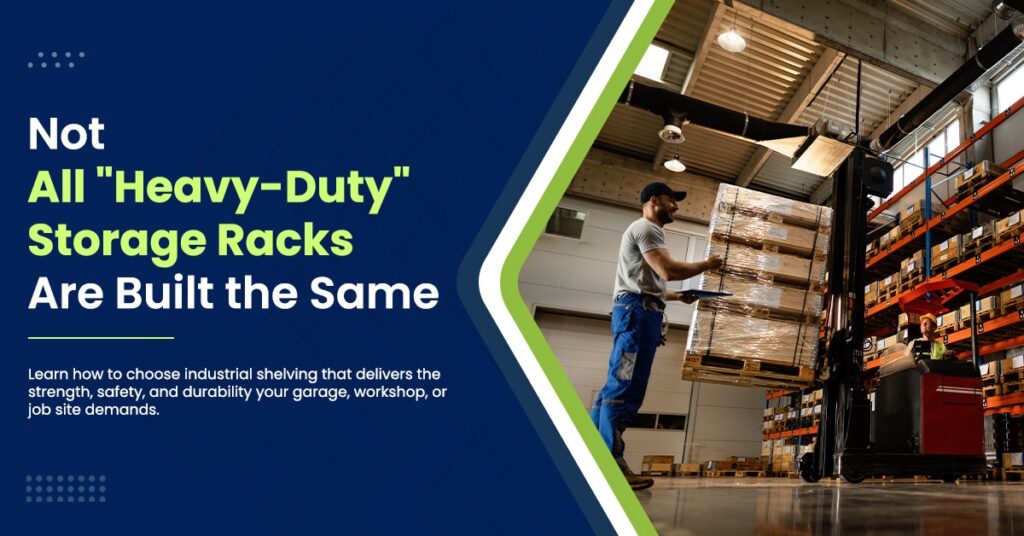
A shelving unit that collapses under load does not fail quietly. It fails all at once with tools on the floor, equipment damaged, and in a workshop or job site environment, the real possibility of injury. The frustrating part is that shelving failures are almost always preventable. They happen when a product labelled ‘heavy duty’ in a big-box store gets used in a context that demands industrial-duty engineering, and the two are not the same thing.
This guide is for procurement teams, distributors, and buyers sourcing storage racks for industrial use – garages, workshops, job sites, and back-of-house environments where the shelving will carry real working loads every day. The focus is on what separates shelving types, how to specify correctly, and what to look for in a manufacturer.
‘Heavy Duty’ Is Not the Same as Industrial Duty
The retail shelving market has diluted the phrase “heavy duty” to the point of meaninglessness, often reducing it to whatever weight figure sits on the box. In reality, whether a rack qualifies as light duty, heavy duty, or a boltless industrial system comes down to engineering – steel gauge, frame construction, connection method, and the duty cycle the unit is actually built for and not a single number.
Storage racks generally fall into three duty classifications:
Light duty shelving is built around one of three shelf-decking types: particle board, laminated board, or wire deck. It’s suited to lighter, lower-frequency storage rather than daily industrial handling. Load ratings for this category typically run from 300 to 1,000 lbs per shelf.
Heavy duty shelving uses steel-gauge framing and shelf decking engineered for sustained industrial loads rather than a single static test. Load ratings for this category run from 1,500 lbs up to 5,000 lbs per shelf.
Boltless (rivet) racks click together without tools and are available across a wider range of tier configurations. Load ratings run from 1,500 lbs up to 5,000 lbs per shelf, typically across 3-tier to 5-tier configurations.
The right classification for your environment depends on how the rack is engineered and how it will actually be used and not just on which number looks most impressive on a spec sheet.
Three Structural Types and the Decision Each One Solves
Industrial storage racks are manufactured in three structural configurations. The right one depends on the environment, the inventory, and how the shelving will be used over time, and not on price alone.
Bolted Shelving: Choose This When Flexibility Matters
Bolted shelving is assembled on-site using hardware connections between uprights and shelf beams. The bolt-and-brace design is what makes it adjustable – shelf heights can be repositioned without dismantling the unit, which matters in environments where the inventory mix changes or where multiple height configurations are needed across a storage area.
The flat-pack logistics are also a practical advantage for procurement teams managing deliveries across multiple locations or retail accounts. Genesis bolted shelving units are available in 3-tier and 4-tier configurations, from 50 to 84 inches wide, 18 to 24 inches deep, with load capacities from 1,500 to 2,500 lbs, sized for the range of professional garage and workshop environments where this type of shelving performs best.
Welded Shelving: Choose This When Consistency and Speed Matter
Welded shelving arrives pre-assembled. The shelf decks are permanently joined to the uprights with nothing to align, no hardware to tighten, and no assembly errors to introduce. It goes from delivery to loaded in the time it takes to position it. For retail receiving areas, maintenance facilities, or any environment where the storage layout is fixed and the shelving needs to be operational immediately, welded is the right call.
The tradeoff is fixed shelf heights. If the inventory profile is stable and defined, that is not a tradeoff at all, but a feature. If it changes frequently, look at bolted instead.
Rivet Shelving: Choose This When Reconfiguration Is Routine
Rivet shelving uses a boltless system wherein shelf beams click into slotted uprights via riveted connectors, no tools required. It is the fastest to assemble and the easiest to reconfigure, which makes it popular in environments where layouts shift, stock rotates frequently, or the same unit needs to serve different purposes across seasons or projects.
It typically sits between bolted and welded in terms of structural rigidity. Genesis boltless/rivet units are rated 1,500 to 3,000 lbs per shelf across 3-tier to 5-tier configurations, with some market options extending up to 5,000 lbs per shelf. For light-to-medium industrial loads in a dynamic environment, rivet shelving is well-suited. For the heaviest sustained loads, bolted or welded will typically be the more appropriate choice.
Safety Isn’t a Separate Checkbox, It’s Built Into the Spec
Most shelving injuries and damage claims don’t come from a defective product. They come from a rack that was never engineered for the load laid on it, or one that was installed without the bracing and anchoring the design assumes. A few things worth confirming before a unit ever gets loaded:
- Anchoring and bracing. Taller units and units in high-traffic garage, workshop, or job site environments should be anchored to a wall or floor per the manufacturer’s instructions, particularly where the unit could be bumped or leaned on.
- Load distribution. Rated capacity assumes weight is distributed evenly across a shelf and across tiers. Concentrating heavy items in one bay or on one shelf can exceed the effective load rating well before the unit reaches its total rated weight.
- Weight limits at the point of use. Posting the per-shelf rating where the unit is used helps prevent overloading by whoever is stocking it day to day, not just the person who specified it.
- Routine inspection. Bolted and rivet connections can loosen or shift with repeated use. A periodic check for deformation, loose hardware, or shifted decking catches problems before they become failures. To create a practical inspection and care routine for your facility, follow our garage shelving maintenance guide.
Getting the duty classification and structural type right at the sourcing stage is the single biggest lever procurement has over safety outcomes down the line, everything after that is maintenance.
How to Specify Industrial Shelving Before You Order
Getting the specification right before ordering saves time, cost, and the risk of a unit that doesn’t perform. These are the factors that matter:
| Specification Factor | What to Confirm |
| Load Capacity | Total rated weight per unit across all tiers combined. Compare against the actual loaded weight of your inventory, not an estimate. Err on the side of more capacity, not less. For a step-by-step approach covering shelf dimensions, available space, load limits, and inventory volume, learn how to calculate shelving capacity before finalizing your order. |
| Tier Configuration | Number of shelves and clearance height between tiers. The tallest item you store determines the minimum clearance needed – confirm this before ordering. |
| Dimensions (W x H x D) | Match unit width and depth to your floor plan. Genesis industrial units range from 50″ to 84″ wide and up to 72″ tall – confirm ceiling height clearance. |
| Steel Gauge & Construction | Heavier gauge steel resists deflection under sustained load. Ask the manufacturer for the gauge specification, not just the load rating. |
| Surface Finish | Powder coating is the standard for professional environments – more durable than painted finishes and resistant to the moisture, grime, and abrasion of a working garage or workshop. |
| Assembly Type | Confirm whether the unit requires on-site assembly (bolted, rivet) or arrives ready to use (welded). Factor assembly time into your deployment plan. |
Genesis Storage Organization: Specified for Real Workloads
Genesis Manufacturing Group’s Storage Organization line covers light duty, heavy duty, and boltless industrial shelving in bolted, welded, and rivet construction – all powder-coated, all engineered for professional garage, workshop, and job site environments. Load capacities across the range run from 300 to 5,000 lbs per shelf, with multiple tier, width, and depth configurations to match different spatial and operational requirements.
For distributors sourcing industrial shelving for retail networks or wholesale accounts, Genesis offers consolidated multi-SKU supply – a mixed range of configurations ordered and delivered without managing separate manufacturer relationships for each product type. The Genesis team works directly with procurement to align specifications, volumes, and delivery schedules.
Key Takeaways
- “Heavy duty” isn’t defined by a load number alone. Whether a rack is light duty, heavy duty, or boltless industrial comes down to steel gauge, construction, and intended duty cycle.
- Market load ratings run from 300 to 1,000 lbs/shelf for light duty, 1,500 to 5,000 lbs/shelf for heavy duty, and 1,500 to 5,000 lbs/shelf (3–5 tier) for boltless racks, and Genesis manufactures across the full range in every category, plus rivet racks and racks with lancing for added configuration flexibility.
- Bolted shelving is the right choice when flexibility matters. Welded when consistency and speed of deployment matter. Rivet when frequent reconfiguration is routine.
- Safety comes down to specification and installation as much as the product itself: correct anchoring, even load distribution, posted weight limits, and routine inspection all matter.
- Always confirm load capacity against actual inventory weight, not estimates. Confirm dimensions against the physical space before ordering.
- Genesis supplies light-duty, heavy-duty, and boltless industrial shelving with consolidated multi-SKU procurement options and a globally responsive sales team.