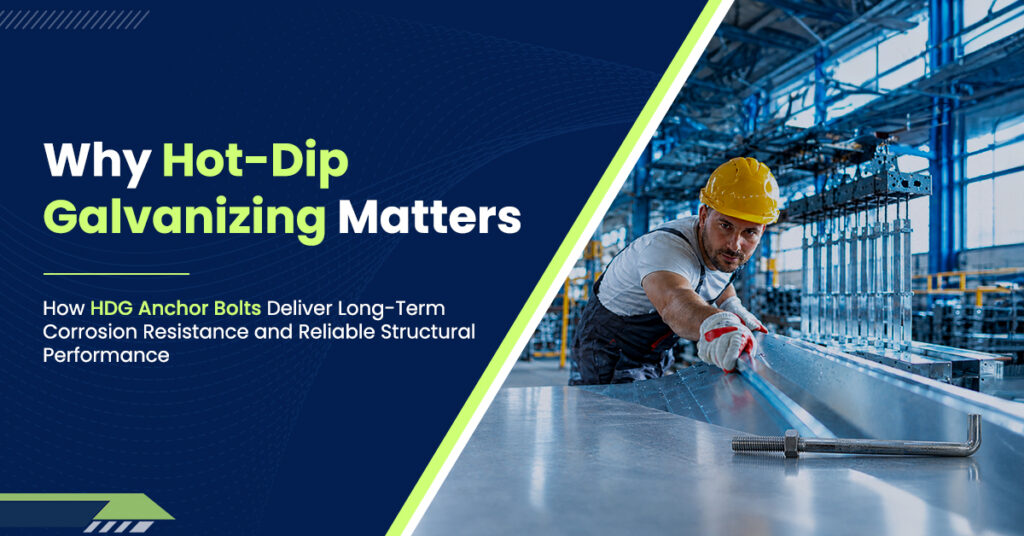
An anchor bolt is one of the only components in a structure you can’t inspect once the job is done. It goes into the concrete, the concrete cures around it, and from that point on, whatever corrosion protection it was built to have is what it’s going to have for the next several decades. There’s no repainting, no re-coating, no swapping it out without breaking into the structure itself.
That’s what makes the galvanizing decision different from most other specification choices. It’s not a matter of picking a finish. It’s the one chance to get the protection right before the bolt disappears into concrete for good. Genesis MG builds its anchor bolt line specifically around hot-dip galvanizing for exactly this reason. But “HDG” on a spec sheet can mean very different things depending on how the coating was actually applied, how thick it ended up, and how well it adheres. Here’s what’s actually happening inside that process, and what to check before you rely on it.
What Actually Happens During Hot-Dip Galvanizing
Hot-dip galvanizing is not a coating applied on top of steel the way paint or electroplating is. It’s a metallurgical reaction between the steel itself and molten zinc, and that distinction is a matter of significance.
The process runs in stages:
- Surface preparation. The bolt is degreased, then pickled in an acid bath to strip mill scale and rust down to bare, reactive steel. A flux step follows, which removes any remaining oxide film and prepares the surface to react with zinc rather than resist it.
- Immersion in molten zinc. The bolt is submerged in a zinc bath held at roughly 840°F (450°C). ASTM B6, the specification governing the zinc metal itself, requires the bath to run at no less than 98% zinc by mass, making it zinc itself, at high purity, doing the actual protective work.
- The metallurgical reaction. While immersed, iron from the steel surface reacts with the zinc to form a series of zinc-iron alloy layers, bonded directly to the base metal, with a layer of relatively pure zinc on the outer surface. This is why a hot-dip coating doesn’t chip or flake the way an electroplated coating can. It is not sitting on the steel but is alloyed into it.
- Centrifuging. For fasteners and hardware specifically (as opposed to large structural shapes), excess zinc is spun off while the coating is still molten, which is what keeps threads and small features from clogging with excess metal.
That last step is also why anchor bolts and other threaded hardware are galvanized under a different standard than structural beams and plates.
ASTM A153 and F2329: The Standards That Actually Governs This
Anchor bolt galvanizing is governed by one of two specifications: ASTM A153, a broad standard covering hot-dip zinc coating on iron and steel hardware generally, or ASTM F2329, a newer specification written specifically for bolts, screws, nuts, and washers. ASTM F1554, the standard that governs anchor bolts themselves, explicitly permits compliance with either one. As distinct from both is ASTM A123, which covers rolled and structural shapes, not threaded hardware. If a supplier quotes A123 for an anchor bolt, that’s the wrong standard for the product category.
A few specifics worth knowing before you order:
- Coating thickness is classified differently under each standard. A153 organizes requirements into classes by material category and part thickness. Class A, for castings and heavier steel hardware, with other classes covering lighter and thinner hardware. F2329 does not use a class system at all but sets a direct minimum thickness requirement for bolts, screws, nuts, and washers instead. The two are not interchangeable numbers and knowing which standard a quote is built around tells you which thickness requirement is in play.
- Threaded areas are handled differently. A153 doesn’t hold the threaded portion of a bolt to the same coating thickness requirement as the shank, because a full-thickness coating on a thread would change its fit. Instead, mating nuts are over-tapped after galvanizing to accommodate the thread’s coating buildup, and the zinc on the bolt’s threads provides the protection for both sides of the connection.
- High-strength fasteners need a specific check. Fasteners above roughly 150 ksi tensile strength can be susceptible to hydrogen embrittlement during the pickling stage. This risk is well understood and manageable, but the controls for it (post-pickling baking, in most cases) are specified as purchaser-driven under ASTM F2329, not automatic on every job. If a buyer doesn’t specifically ask for it, there’s no guarantee it happened. At the highest strength grades, some standards discourage hot-dip galvanizing altogether, which is worth knowing before specifying HDG on a very high-strength anchor bolt in the first place.
- A related standard, ASTM F2329, was introduced specifically to cover bolts, nuts, and washers with requirements more tailored to threaded fasteners than A153’s original Class C. Both standards are still in active use, and it’s worth knowing which one a given quote is actually referencing.
Adhesion: Why It Doesn’t Just Sit There
Because the zinc-iron layers form through diffusion rather than mechanical or electrochemical deposition, a properly executed HDG coating is bonded across its full surface and is not just tacked on at points of contact. That’s the practical reason hot-dip coatings tolerate handling, transport, and installation abuse such as dragging across a truck bed, driving into concrete, exposure to job site debris, far better than a thinner, non-metallurgically-bonded coating would.
It’s also why coating failure in a properly galvanized bolt is rare as a bonding problem and much more common as a thickness problem. A coating that’s too thin for its exposure environment wears through faster, not because it peels off, but because there simply isn’t enough zinc there to keep sacrificing itself.
Service Life Comes Down to Thickness and Environment and Not the Coating Type Alone
HDG anchor bolts are broadly rated for 20 to 50 years of service life in general outdoor construction environments. Where a specific installation falls in that range comes down to two things. First, how much coating was actually deposited and second, how aggressive the exposure environment actually is.
A bolt that meets the minimum coating thickness for its class in a dry, low-chloride environment will likely land at the higher end of that range. The same bolt in an environment with de-icing salts, coastal humidity, or industrial chemical exposure will wear through its zinc layer faster. This is not because the galvanizing failed, but because the coating is being consumed faster than it would be in a milder setting. This is also the point at which stainless steel or duplex coating systems become the more appropriate specification, but that’s a materials decision that sits outside what HDG itself is designed to solve.
How This Gets Verified
A coating thickness requirement is only as good as the ability to confirm it was actually met. Genesis MG’s in-house testing includes coating weight analysis and salt spray testing on galvanized hardware, alongside tensile testing, dimensional analysis, and bend yield checks – run under an ISO 9001:2015-aligned quality system with full batch traceability back to raw material and process data.
That combination is what turns “HDG” from a claim into something a procurement team can actually verify. A coating weight measurement confirms the zinc layer meets the class requirement it was ordered against, and salt spray testing gives a comparative read – against a threshold or against other coatings, not a direct forecast of real-world years – on how that coating will hold up under accelerated corrosion exposure before the bolt ever reaches a job site.
What to Ask a Supplier Before You Order HDG Anchor Bolts
- Which A153 class (or F2329 equivalent) is the coating being produced to, and does that match the part’s material category and thickness?
- Can they provide a coating weight or thickness test report, not just a certificate of conformance?
- How is thread fit being handled? Is the nut over-tapped to accommodate the bolt’s coating buildup?
- For high-strength grades, what’s being done to control for hydrogen embrittlement during pickling?
- Is salt spray or equivalent accelerated corrosion testing part of routine batch verification, or only done on request?
The Class on the Spec Sheet Only Matters If Someone Checks It
Every point in this piece traces back to one thing: an HDG anchor bolt’s real service life is decided at the point of manufacture and not at the point of installation. Once it’s embedded, there’s no way to add coating thickness it doesn’t already have, and no way to retroactively verify a class it wasn’t actually produced to.
That puts the actual leverage in a slightly different place than most buyers assume. It’s not in choosing HDG over another coating type. For the vast majority of general construction and commercial applications, that choice is already right. The leverage is in confirming, before the order ships, that the specific class was met and tested, not just claimed on a certificate.
A coating weight test report and a salt spray result are the difference between an anchor bolt that’s probably fine and one that’s verified fine for the environment it’s going into. For a component you’ll never see again after the concrete cures, that difference is the entire point of specifying HDG in the first place.
Specifying HDG anchor bolts for a project where a 30-year service life isn’t optional?
Talk to the Genesis team about coating class, verification reports, and lead times before the order ships and not after a failure forces the conversation.