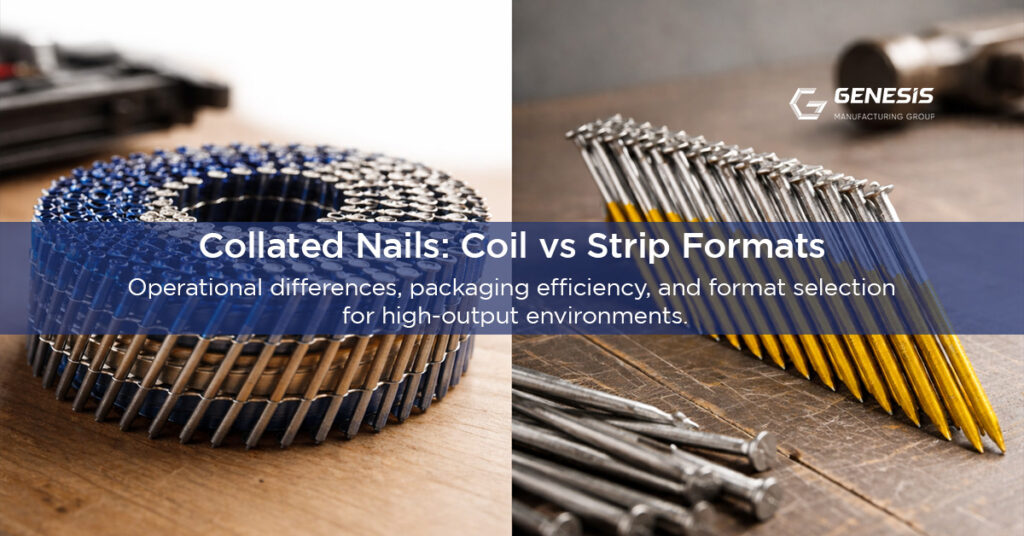
On high-output job sites and inside pallet manufacturing lines, nails are not a minor consumable, but they directly influence productivity. When those nails are used in pneumatic systems, they are almost always collated. For distributors and importers evaluating large-volume purchases, the discussion often falls within the collated category: coil nails or strip (stick) nails.
Both formats are engineered for pneumatic nailers. Both are widely used across framing and industrial applications. But differences in reload frequency, tool weight, packaging density, and workflow impact can materially affect output efficiency and landed cost.
Manufacturers like Genesis MG supply both formats at scale. Understanding how each behaves in real-world production and sourcing environments allows buyers to align tool ecosystems, container planning, and supply stability more effectively.
Let’s examine the distinction in practical terms.
What Are Collated Nails?
Collated nails are nails joined together using wire, plastic, or paper to allow continuous feeding inside pneumatic nailers. Unlike loose bulk nails, collated formats are engineered for speed, rhythm, and repeatability.
Let’s now consider the two primary formats of collated nails – coil nails and strip (stick) nails, which help improve sourcing decisions.
Coil Nails in High-Output Environments
Coil nails are arranged in a circular roll and typically wire- or plastic-collated. Because of their compact spiral format, they hold a large number of nails in a single load. That single design difference drives several operational advantages.
Where Coil Nails Excel
- Pallet and crate manufacturing
- Industrial assembly lines
- High-volume framing environments
- Semi-automated production
In environments where hundreds of nails are fired in minutes, fewer reloads mean:
- Less downtime
- Higher output consistency
- Smoother operator workflow
For buyers placing high-volume quantities of collated fasteners, coil nails often reduce reload interruptions and increase throughput stability. However, coil nailers are generally heavier, have a slightly higher tool cost, and are not always necessary for low-volume site work.
When production speed matters more than tool weight, coil formats dominate.
Strip (Stick) Nails: Key Benefits in Mobility-Focused Work
Strip nails, sometimes called stick nails, are arranged in straight rows and collated using paper, plastic, or wire. They are commonly used in framing and finish nailers. When discussing stick nails vs coil, the real distinction comes down to mobility and tool ergonomics.
Core Strip Nail Benefits:
- Lighter, more maneuverable tools
- Better balance for overhead fastening
- Improved visibility for precision work
Strip formats are widely used for residential framing, interior structural work, trim carpentry, and situations requiring climbing or overhead installation. Because strip nailers carry fewer nails per load, they reduce tool weight, which can improve operator comfort during extended on-site use.
However, strip nails need more frequent reloads, they have a larger packaging footprint compared to coils, and are less efficient in continuous industrial production. For contractors prioritizing maneuverability over volume, strip nails make sense.
Pros and Cons Comparison
| Category | Advantages | Limitations |
| Coil Nails | • Long uninterrupted firing cycles • Compact storage footprint • Ideal for high-output environments • Efficient for large-scale collated nails high-volume orders | • Heavier nailers • Higher tool cost • Not required for low-volume work |
| Strip (Stick) Nails | • Lightweight and ergonomic tools • Easier handling on-site • Well-suited for framing and overhead work • Clear strip nail benefits for mobility-focused tasks | • More reload frequency • Larger carton volume • Slower in mass production settings |
Packaging & Shipping Efficiency: What Buyers Should Consider
In global trade, packaging geometry matters. Coil nails, because of their compact spiral form, stack efficiently in cartons and containers. Strip nails, being elongated, occupy more linear space.
For importers moving 20-foot or 40-foot containers, this difference can affect:
- Carton count per container
- Freight cost per unit
- Warehouse stacking efficiency
Genesis MG supports procurement teams with:
- Optimized carton sizing
- Private labelling and custom artwork
- Embossed nail heads
- Region-specific packaging formats
- Moisture-resistant cartons for coastal markets
Introducing packaging customization early in sourcing discussions helps stabilize landed cost and maintain brand consistency.
Restocking Strategy in a Volatile Market
Global supply chains are no longer predictable. Hence, when evaluating suppliers for collated formats, procurement teams increasingly prioritize:
- Production flexibility
- Capacity to scale output quickly
- Packaging agility
- Custom specification capability
- Consistent batch quality
For high-volume users of collated nails, an uninterrupted supply protects entire manufacturing lines from slowdown.
Compatibility: What Should Buyers Confirm Before Ordering?
Selecting the right collated format requires more than choosing coil or strip.
- Tool & Collation Match
Verify compatibility with wire, plastic, or paper collation types. Incorrect matching causes jams and tool wear. - Material & Coating Selection
Electro-galvanized (EG), hot-dip galvanized (HDG), phosphate, or bright finish must align with exposure conditions and code requirements. - Application Requirements
Framing, pallets, sheathing, crates, and decking each demand specific shank profiles and head styles. - Head & Shank Design
Smooth, spiral, and ring shanks influence withdrawal resistance. Full-round or clipped heads affect compliance and load behavior. - Regional Code Compliance
Exterior work and treated lumber often require HDG fasteners.
A structured evaluation reduces field failures and improves long-term performance.
Stick Nails vs Coil: When Should You Choose Each?
Choose Coil Nails when:
- Output volume is high
- Reload interruptions must be minimized
- Storage footprint matters
- Production-line consistency is critical
Choose Strip (Stick) Nails when:
- Mobility matters
- Tool weight is a factor
- Overhead work is frequent
- Precision framing dominates
It is crucial to always bear in mind that there is no universal winner and the right format depends on workflow, tool ecosystem, and production rhythm.
The Bigger Picture: Stability in Supply
More than being consumables, collated fasteners are workflow enablers. Whether comparing stick nails vs coil, evaluating strip nail benefits, or placing recurring orders for collated formats, the real objective remains predictable performance and reliable supply. For buyers placing high-volume orders for collated fasteners, format alignment directly affects workflow efficiency.
Genesis Manufacturing Group supports distributors and importers with:
- ISO-aligned process control
- Uniform wire drawing and shank geometry
- Reliable collation integrity
- Consistent coating thickness
- Global export capability
When consistency is engineered at the manufacturing level, installation performance becomes predictable on-site.
If you are sourcing coil or strip collated nails for framing, pallets, or industrial assembly, the right conversation is not just about price, but about format alignment, packaging efficiency, and supply resilience.
Request a quote or technical discussion with Genesis MG to evaluate the right collated nail format for your application and volume strategy.
Because in fastening, while speed matters, consistency matters more.