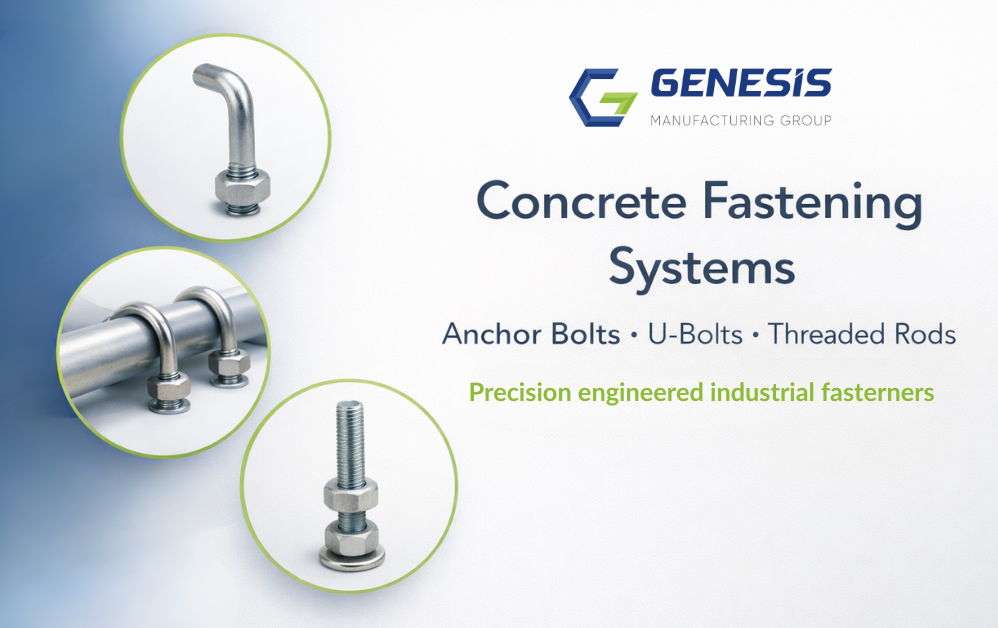
Concrete structures, whether part of industrial facilities, commercial buildings, bridges, or residential projects, depend heavily on the fastening hardware embedded within them. While concrete provides compressive strength, it is concrete accessories such as anchor bolts, U-bolts, and threaded rods that enable structural elements, machinery, and services to be securely connected and stabilized.
These components may not be visible once construction is complete, but their performance directly influences structural integrity, safety, and long-term durability. Understanding how each accessory functions, where it should be used, and how quality is maintained during manufacturing is essential for builders, engineers, contractors, and facility managers responsible for reliable construction outcomes.
This guide explains the role of key concrete accessories, outlines their typical applications, and highlights the importance of consistent manufacturing and quality controls in ensuring dependable performance.
What Are Concrete Accessories and Why Do They Matter?
Concrete accessories are metal fasteners and connection components designed to anchor, secure, or reinforce structures within or onto concrete foundations. While concrete is strong in compression, it relies on these accessories to transfer loads, resist movement, and maintain alignment between structural and mechanical elements.
Common concrete accessories include:
- Anchor bolts (cast-in-place, epoxy-set, sleeve anchors)
- U-bolts for securing pipes, conduits, and round sections
- Threaded rods for tensioning, bracing, and extended connections
Together, these components help ensure that:
- Structural loads are distributed safely
- Equipment remains securely mounted
- Pipes and supports stay aligned
- Foundations and steel members function as a unified system
In regulated construction environments, the performance of concrete accessories is closely tied to material consistency, dimensional accuracy, and controlled manufacturing processes. Manufacturers operating under structured quality systems such as ISO 9001 are better positioned to deliver repeatable, predictable performance across projects. Genesis Manufacturing Group follows such quality-controlled manufacturing practices to support consistent fastening performance in structural and industrial applications.
Anchor Bolts: The Foundation of Structural Connections
Anchor bolts play a central role in connecting concrete foundations to the structures, equipment, or framing systems installed above them. They form the critical interface that allows loads to move safely between concrete and steel, ensuring that columns, machinery, base plates, and industrial systems remain stable over long periods of use. It is, therefore, valuable for buyers and specifiers to understand how anchor bolts function across different applications and why their material quality and dimensional consistency directly influence performance.
Where Anchor Bolts Are Commonly Used
Anchor bolts are essential in a wide range of environments, including:
- Structural foundations (columns, frames, building supports)
- Industrial equipment bases (machinery, compressors, pumps)
- Infrastructure and utilities (rails, platforms, mounted systems)
- Commercial and warehouse environments (racking, mechanical supports)
Across these applications, anchor bolts must consistently handle tension, shear, uplift, and vibration forces. Their long-term reliability depends on the quality of steel used, the precision of the threading, and the durability of protective coatings.
Why Anchor Bolt Quality Matters to Buyers
Anchor bolt failures often trace back to inconsistencies in manufacturing rather than design. Variations in material grade, thread geometry, or coating uniformity can influence:
- Load transfer efficiency
- Alignment accuracy
- Fatigue resistance
- Long-term corrosion performance
For critical structures, even small dimensional deviations can affect base plate fitment or create uneven load paths. As a result, procurement teams increasingly prioritize suppliers with disciplined process controls, documented inspection methods, and reliable material sourcing. Genesis Manufacturing Group produces anchor bolts through ISO 9001-aligned quality systems, emphasizing controlled raw material selection, multi-stage dimensional inspection, verified coating thickness and adhesion, consistent thread forming and fitment accuracy, and full batch traceability. This structured manufacturing approach ensures that every anchor bolt consistently meets mechanical, chemical, and dimensional requirements across production lots.
U-Bolts: Versatile Fasteners for Pipes and Supports
U-bolts are named for their U-shaped profile and threaded ends. Despite their simple design, they play a critical role in securing cylindrical elements within concrete and structural systems.
Common Uses of U-Bolts
U-bolts are widely used to secure:
- Pipes and conduit lines
- HVAC ducting
- Electrical conduits
- Tubular frames
- Support beams
- Industrial piping systems
When mounted to concrete ceilings, walls, or frames, U-bolts provide a stable clamping mechanism that supports alignment while allowing adjustment during installation.
Advantages of U-Bolts
- Strong holding power for cylindrical components
- Even load distribution, reducing localized stress
- Compatibility with seismic bracing systems
- Availability in corrosion-resistant materials
For environments exposed to moisture or chemicals, stainless steel or hot-dip galvanized U-bolts are commonly specified to reduce long-term degradation.
Threaded Rods: Flexible and Adaptable Fastening Solutions
Threaded rods, often called “all-thread, are long, continuously threaded metal rods used across construction, mechanical, and industrial applications. Their ability to be cut to length and paired with nuts and washers makes them highly adaptable.
Common Applications
Threaded rods are used for:
- Foundation anchoring
- Suspended ceilings
- Pipe supports
- Mounting heavy equipment
- Structural bracing
- Tie-downs and hold-downs
- Connecting steel plates or beams
Types of Threaded Rods
Standard Carbon Steel Rods
Used for general construction and moderate load requirements.
High-Strength Threaded Rods
Manufactured from alloy steel or stainless steel to provide:
- Higher tensile strength
- Improved corrosion resistance
- Suitability for high-load and dynamic environments
Genesis MG supplies threaded rods in multiple grades and finishes, produced under controlled manufacturing conditions to support structural and industrial applications requiring consistent performance.
Supplier Qualification and Quality Controls
The reliability of concrete accessories begins long before installation. It starts with supplier qualification and manufacturing discipline. When sourcing fasteners, buyers should look beyond pricing to evaluate whether manufacturers follow documented quality systems and inspection protocols.
Key aspects to verify include:
- Controlled raw material selection
- In-process dimensional checks
- Consistent surface finishing and coatings
- Batch traceability and inspection records
Genesis MG operates under ISO 9001–aligned quality management systems, supporting repeatable production processes and verification at multiple stages of manufacturing. These controls help ensure that anchor bolts, U-bolts, and threaded rods meet specified mechanical and dimensional requirements consistently across projects and geographies.
How to Choose the Right Concrete Accessory
Selecting the correct concrete accessory depends on understanding both application demands and environmental conditions.
Consider Load Requirements
- Anchor bolts handle tension, shear, and uplift
- U-bolts provide clamping and stabilization
- Threaded rods support tension and bracing
Consider Environmental Exposure
- Moisture, chemicals, and temperature variations accelerate corrosion
- Hot-dip galvanized or stainless steel finishes extend service life
Consider Application Type
- Cast-in-place anchors for new foundations
- Epoxy anchors for retrofits
- U-bolts for pipes and conduits
- Threaded rods for extended connections and bracing
Using the wrong accessory can reduce load capacity or cause premature failure.
Why Quality Matters in Concrete Accessories
Fasteners may appear small compared to concrete slabs or steel beams, but they are the components that hold everything together. Variations in material grade, thread accuracy, or coating quality can directly affect load transfer, alignment, and durability.
This is why experienced builders rely on manufacturers with documented quality systems and consistent production controls. Genesis MG’s concrete accessories are produced under ISO-certified manufacturing environments, with controlled material verification, precision threading, and reliable surface finishing designed to support predictable performance in structural and industrial settings.
Remember
Concrete accessories may be hidden once construction is complete, but their role is fundamental. Anchor bolts secure structures to foundations. U-bolts stabilize pipes and conduits. Threaded rods provide tension and bracing. Together, they form the hidden support system that ensures concrete-based structures remain safe, stable, and durable.
By selecting the right accessories and sourcing them from manufacturers with disciplined quality controls, builders and engineers can reduce risk, improve reliability, and extend the service life of their structures.
For informed guidance on selecting concrete accessories suited to your project demands,
Genesis Manufacturing Group offers seasoned expertise.
Meta Title:
Concrete Accessories 101: Anchor Bolts, U-Bolts, and Threaded Rods Explained
Meta Description:
A practical guide to anchor bolts, U-bolts, and threaded rods, exploring applications, quality considerations, and best practices for reliable concrete fastening systems.