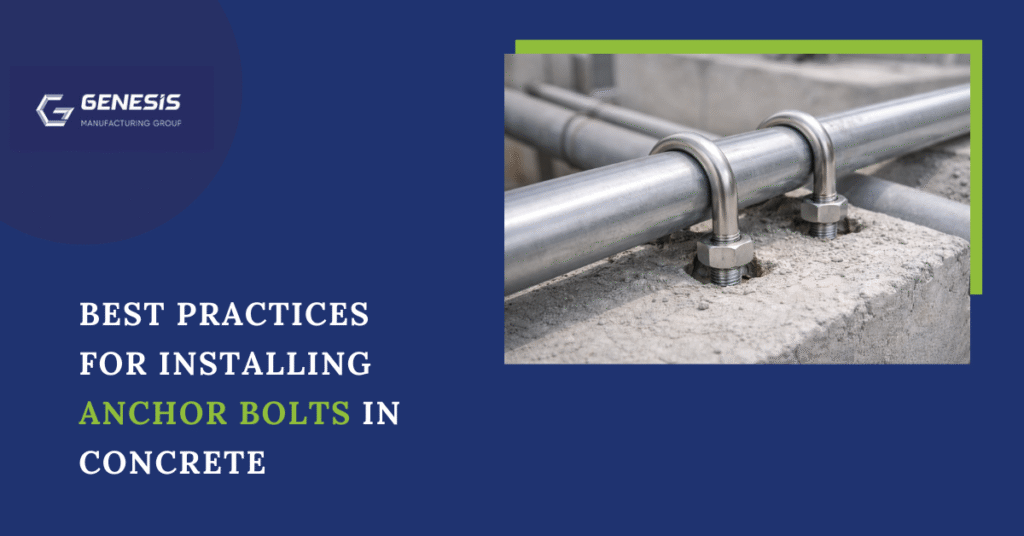
Anchor bolts play a critical role in concrete construction by forming the structural connection between concrete foundations and the components they support. Whether anchoring steel columns, securing industrial machinery, or stabilizing infrastructure elements, anchor bolts must reliably transfer loads while maintaining alignment and long-term stability.
When anchor bolts are installed correctly, they help prevent movement, resist uplift forces, and support safe load distribution throughout the structure. Improper installation, however, can result in misalignment, reduced load capacity, or premature failure, all of which are issues that are difficult and costly to correct once concrete has cured.
This guide outlines best practices for installing anchor bolts in concrete, covering preparation, installation techniques, curing considerations, and common quality checks. It is intended to help builders, contractors, and maintenance teams achieve dependable fastening performance while minimizing installation errors.
Understand Anchor Bolt Types Before Installation
Selecting the correct type of anchor bolt for concrete is the first step toward a successful installation. Each anchor type is designed for specific conditions and load requirements, and using the wrong type can compromise both performance and safety.
Cast-in-Place Anchor Bolts
Cast-in-place anchor bolts are positioned within formwork before concrete is poured. As the concrete cures, the bolt becomes permanently embedded, creating a strong mechanical bond.
Common applications include:
- Structural steel columns
- Foundation base plates
- Industrial equipment foundations
- Bridge railings and barriers
Epoxy-Set Anchor Bolts
Epoxy-set anchors are installed into cured concrete by drilling a hole, injecting structural epoxy, and inserting the bolt.
Typically used for:
- Retrofitting existing structures
- Equipment relocation
- Repairs and modifications
- Applications requiring precise bolt placement
These anchors offer flexibility while still supporting high load capacities when surface preparation and curing procedures are followed correctly.
Mechanical (Sleeve) Anchor Bolts
Mechanical or sleeve anchors expand within the drilled hole when tightened.
Best suited for:
- Light to medium-duty loads
- Masonry and hollow concrete
- Wall-mounted fixtures
- Smaller equipment mounts
They are quick to install but are not intended for heavy structural applications or high dynamic loads.
Proper Preparation: The Foundation of Successful Installation
Anchor bolt performance is heavily influenced by preparation. Skipping or rushing early steps often leads to alignment issues, reduced holding strength, or premature failure.
Review Structural Drawings Carefully
Anchor bolt placement must always follow approved engineering drawings, which define bolt spacing, embedment depth, diameter and grade, and orientation and edge distances. Errors at this stage can cause major downstream issues, including misaligned base plates or equipment that cannot be installed correctly.
Use Accurate Templates for Cast-in-Place Anchors
Templates (or bolt jigs) help maintain vertical alignment, correct spacing, and consistent elevation. Without a rigid template, bolts can shift during concrete placement or vibration. This risk increases with larger-diameter or higher-grade anchor bolts commonly used in structural foundations.
Confirm Concrete Strength Before Loading
Even perfectly installed anchor bolts can fail if loads are applied before the concrete has reached sufficient strength. Some of the general guidelines to ensure include:
- Allowing concrete to reach at least 70% of its specified compressive strength before applying load
- For structural applications, wait until full cure (typically 28 days) unless engineering approval states otherwise
Always verify curing requirements based on project specifications and concrete mix design.
Best Practices for Installing Cast-in-Place Anchor Bolts
Cast-in-place anchors provide high load capacity but require careful execution.
Secure Templates Firmly
Templates should be braced to prevent movement during concrete placement and vibration. Even minor shifts can cause bolts to lean or drift out of tolerance.
Verify Embedment Depth
Embedment depth directly affects pullout strength and load performance. Measure both the bolt projection above the concrete and the required embedment below the surface. Confirm dimensions before pouring to avoid corrective work later.
Place Concrete Carefully Around Bolts
Aggressive tamping near anchor bolts can push them out of alignment. Instead, pour concrete in controlled layers, use vibration sparingly to remove air pockets, and monitor bolt verticality throughout placement.
Protect Bolts During Curing
Anchor bolts should remain undisturbed while concrete cures. Any movement during this period weakens the bond between steel and concrete.
Best Practices for Installing Epoxy-Set Anchor Bolts
Epoxy anchors rely heavily on surface preparation and controlled curing.
Drill Accurate, Clean Holes
Hole diameter and depth must match manufacturer specifications. After drilling:
- Blow out dust with compressed air
- Brush with a nylon hole brush
- Blow out again
Residual debris prevents epoxy from bonding properly.
Follow Epoxy Mixing and Temperature Guidelines
Structural epoxies have defined working times and temperature ranges. Improper mixing or curing conditions reduce bond strength and long-term performance.
Insert Bolts with Controlled Rotation
Gently twisting the bolt during insertion helps distribute epoxy evenly and eliminates trapped air.
Allow Full Cure Before Loading
Loads should not be applied until the epoxy has fully cured. Cure times vary based on temperature and product formulation.
Best Practices for Installing Mechanical Anchors
Mechanical anchors depend on friction and expansion, making installation precision critical.
- Drill holes to the exact specified diameter
- Avoid oversized holes, which reduce holding strength
- Use a torque wrench to prevent over-tightening
Over-torqueing can crack concrete, damage the anchor, or prevent proper expansion.
Common Mistakes to Avoid
Even experienced installers encounter issues that compromise anchor bolt performance. Common errors include:
- Misaligned bolts due to unstable templates
- Insufficient embedment depth
- Using anchor types not rated for the applied load
- Installing bolts too close to slab edges
- Inadequate hole cleaning for epoxy anchors
- Applying load before concrete or epoxy has cured
- Over-tightening mechanical anchors
Avoiding these mistakes improves installation reliability and reduces long-term maintenance risks.
Why Hardware Quality Matters
Correct installation cannot compensate for poor-quality hardware. Anchor bolt performance depends on:
- Material grade
- Coating consistency
- Dimensional accuracy
- Thread quality
- Controlled heat treatment
Manufacturers operating under structured quality systems help ensure these characteristics remain consistent. Genesis Manufacturing Group produces anchor bolts and related fastening components under ISO 9001–aligned quality controls, supporting repeatable material properties, verified dimensions, and reliable surface finishes suitable for demanding construction environments.
Remember
Installing anchor bolts in concrete is a critical construction step that demands careful planning, accurate execution, and dependable hardware. By understanding anchor types, following preparation and curing guidelines, and avoiding common installation errors, builders and engineers can ensure long-term structural stability and safety.
Consistent installation practices, combined with quality-controlled fastening components, reduce risk and improve performance across foundations, equipment bases, and structural connections.
Genesis Manufacturing Group provides informed support for anchor bolt selection and installation tailored to structural requirements.
Meta Title:
Best Practices for Installing Anchor Bolts in Concrete
Meta Description:
A practical guide to anchor bolt installation in concrete, covering preparation, installation methods, curing requirements, and quality considerations for reliable structural performance.