On most construction sites, nails look simple enough. They are those small metal fasteners that hold everything together. But anyone who has worked on coastal projects, humid interiors, or long-term outdoor structures knows one thing clearly → Rust doesn’t negotiate.
So, if you choose the wrong fastener, moisture, chlorides, and weather eventually take over.
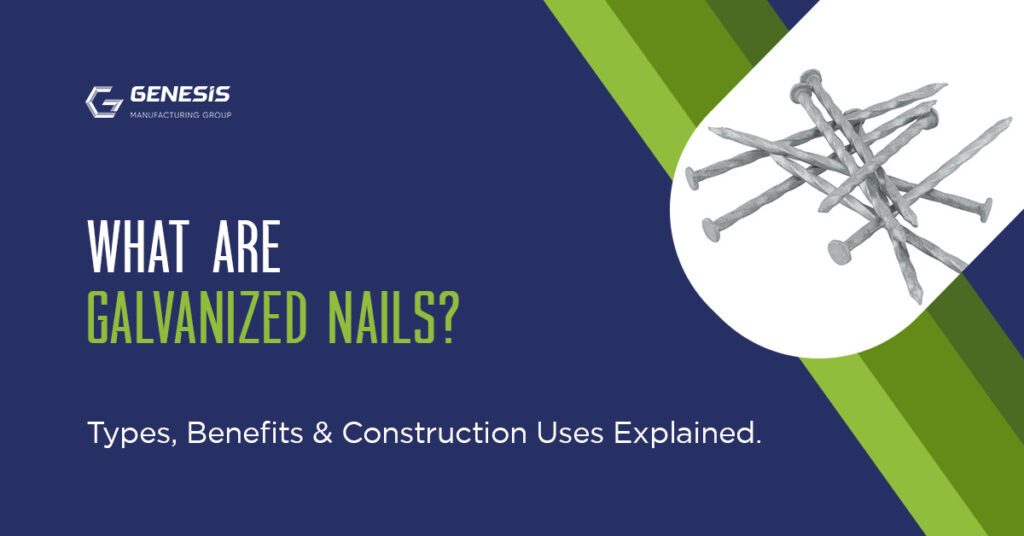
That’s where galvanized nails come in. They are one of the most widely used corrosion-resistant nails in construction, designed to slow down rusting and extend the life of wood-to-wood and wood-to-metal connections.
But what exactly makes a nail “galvanized”? And will galvanized nails rust at all? Let’s break it down in a practical, builder-friendly way.
What Are Galvanized Nails and Why Are They Used?
Galvanized nails are steel nails coated with zinc to create a barrier that slows corrosion. When moisture reaches steel, rust begins quickly. Zinc delays this process because it corrodes much more slowly and even acts as a sacrificial layer that protects the underlying metal. In simple terms,
- Steel = strong but rust-prone
- Zinc coating = armor that buys time
So when people ask, “Are galvanized nails rust-proof?” the accurate answer is, Galvanized nails are rust-resistant, not rust-proof. They last significantly longer than plain steel nails, especially outdoors, but can still corrode under extreme or long-term exposure. They hit a sweet spot between affordability, performance, and general-purpose durability, which is why builders reach for them every day.
How Are Galvanized Nails Made?
There are two common manufacturing processes, each producing a different style of coating.
1. Electro-Galvanized (EG)
A thin zinc coating is applied using an electric current. Nails made by this process are smooth, have a uniform finish, are best for interior or mildly exposed environments, and are not ideal for long-term outdoor moisture.
2. Hot-Dip Galvanized (HDG)
In this process, nails are dipped into molten zinc, forming a thick, rugged coating. This produces the highest corrosion resistance among galvanized types that are suitable for coastal areas, outdoor structures, landscaping, roofing, and fencing, and have a slightly rougher surface.
Most construction codes prefer hot-dip galvanizing where moisture exposure is expected. The manufacturing process typically adheres to ASTM A153 for zinc-coated hardware such as nails, and ASTM F1667 for dimensional standards, ensuring coating thickness, adhesion, and nail geometry remain consistent.
Why Manufacturing Quality Matters
Not all galvanized nails perform the same way. Coating thickness, adhesion, and shank geometry directly influence how long a nail resists corrosion and how consistently it drives on site. Manufacturers such as Genesis MG, who follow ISO-aligned coating and dimensional controls, help ensure that galvanized nails maintain reliable performance across different batches and environments, something builders rely on when projects span months or years.
Types of Galvanized Nails You’ll Commonly See on Site
Different applications demand different nail formats. The most widely used include:
- Common Nails
General construction, framing, and structural woodwork. - Roofing Nails
Short shank, large head – ideal for shingles and roofing sheets. - Collated Nails (Plastic or Wire Collated)
Designed for high-speed pneumatic nailers used in framing, pallet building, crates, and packaging. - Finishing Nails
For interior trim, moulding, and carpentry. - Duplex / Double-Headed Nails
Temporary structures, formwork, scaffolding. - Spiral or Ring Shank Nails
Enhanced withdrawal resistance for decking, flooring, fencing, and pallets. Each one can be galvanized depending on where and how it will be used.
Benefits of Using Galvanized Nails
- Better Corrosion Resistance
The zinc coating protects against moisture, early rust formation, and atmospheric exposure.
- Higher Durability Than Plain Steel
Galvanized nails survive environments where uncoated nail steel would fail quickly.
- Cost-Effective vs Stainless Steel
You get strong rust protection without the premium cost of 304 or 316 stainless steel.
- Compatibility with Outdoor Wood
Pressure-treated lumber, fencing, decking, and formwork all benefit from galvanized fasteners.
- Predictable Performance in Typical Site Conditions
When fasteners meet coating guidelines (ASTM A153) and dimensional standards (ASTM F1667), builders get higher consistency across batches.
Are Galvanized Nails Better Than Stainless Steel Nails?
This is one of the most common questions contractors ask:
What’s the Difference? Galvanized vs Stainless Steel Nails
| Feature | Galvanized Nails | Stainless Steel Nails |
| Corrosion Resistance | Good (zinc slows rust) | Excellent, especially 304/316 |
| Cost | Affordable | More expensive |
| Longevity | Moderate to high | Very high |
| Best Use Cases | General construction, outdoor wood | Coastal zones, marine, chemical exposure |
| Rust Proof? | Rust-resistant | Closer to rust-proof |
If someone asks, “What type of screws don’t rust?” The accurate answer is Stainless steel fasteners (304/316) resist corrosion the best, especially in chloride-rich or marine environments.
So while galvanized fasteners perform very well for common outdoor applications, stainless steel remains the premium choice where long-term corrosion is a critical concern.
How to Choose the Right Galvanized Nail
A few quick checks can prevent failures when it comes to choosing the right galvanized nail.
1. Match the Coating to the Environment
- Dry interiors → Electro-galvanized
- Outdoor exposure → Hot-dip galvanized
- Coastal or high-chloride conditions → Stainless steel preferred
2. Check Lumber Compatibility
Pressure-treated wood often requires HDG or stainless steel.
3. Confirm Dimensional Accuracy
This ensures consistent driving, reduced bending, and fewer jams in nail guns. Genesis MG follows ASTM F1667 guidelines for nail geometry.
4. Choose the Right Shank Type
- Smooth → General use
- Ring → Decking, sheathing
- Spiral → Better pull-out resistance
5. Ensure Reliable Manufacturing Controls
Variations in zinc thickness or nail hardness directly affect durability.
Quality and Consistency: How Genesis MG Approaches Galvanized Fasteners
Genesis MG manufactures galvanized and coated nails under controlled, ISO-aligned processes to ensure consistent layer thickness, proper adhesion, and precise nail geometry. Our experience in producing large-volume collated nails (plastic collated, wire collated, ring shank, screw shank) ensures:
- Stable driving performance in pneumatic tools
- Uniform coatings across batches
- Dimensional repeatability
- Strong withdrawal resistance
Rather than relying on “heavy coatings,” Genesis focuses on controlled and consistent coatings, which is what actually influence long-term corrosion resistance.
Remember!
Galvanized nails may look ordinary, but the zinc coating behind them makes a meaningful difference, especially when working outdoors or in moisture-prone environments. They bridge the gap between cost efficiency and corrosion resistance, offering predictable performance in the majority of construction settings.
Understanding what galvanized nails are, how they are made, and where they work best helps builders choose the right fastener for each job, while avoiding premature rust or structural issues.
For applications that demand higher corrosion performance, stainless steel remains the superior choice. But for most day-to-day construction, high-quality galvanized nails from controlled manufacturing processes provide the durability and reliability that modern sites expect.
Frequently Asked Questions:
Galvanized nails are steel nails coated with zinc to slow corrosion, while regular nails are plain steel and rust much faster when exposed to moisture. The zinc layer acts as a protective barrier, making galvanized nails more suitable for outdoor or humid environments.
Galvanized nails are commonly used for framing, decking, fencing, roofing, outdoor woodwork, landscaping, and general construction where moderate moisture exposure is expected. They offer greater durability than plain steel nails under typical outdoor conditions.
Avoid galvanized nails in marine, coastal, or chemical-exposed environments where long-term corrosion resistance is critical. In these conditions, stainless steel fasteners (304 or 316) are usually the better choice.
Yes, galvanized nails can eventually rust because they are rust-resistant, not rust-proof. The zinc coating significantly slows corrosion but may degrade over time under prolonged exposure to moisture or harsh environmental conditions.
Hot-dip galvanized nails are widely used for general outdoor construction. For coastal areas, marine environments, or high-chloride exposure, stainless steel nails provide the highest level of corrosion resistance.
Yes, galvanized nails can be used in untreated wood and often provide greater durability than plain steel nails, especially in areas exposed to humidity or occasional outdoor conditions.