Concrete looks unshakeable. It’s strong in compression, long-lasting, and trusted across industrial structures, highways, bridges, and foundations. But there’s one part of a concrete system that quietly faces far greater stress → The fasteners and concrete accessories inside it.
Whether it’s anchor bolts holding down machinery bases, threaded rods reinforcing formwork, or inserts securing façade systems, these components face corrosion pressures that concrete itself never sees. Once embedded, replacing them can be costly or near impossible, making the choice of corrosion-resistant fasteners a critical design decision rather than a last-minute purchase.
For engineers, builders, and facility managers targeting long-term reliability, understanding how corrosion works inside concrete and how the right materials, coatings, and design strategies prevent it can dramatically extend the service life of a structure.
Let’s break it down in a practical way.
Why Fasteners Inside Concrete Corrode: The Two Big Mechanisms
Concrete environments might look “protected,” but fasteners inside them face unique corrosion triggers that evolve over decades.
1. Chloride Attack (The Most Aggressive Mechanism)
Chlorides come from seawater, de-icing salts, industrial chemicals, or groundwater.
Once they penetrate concrete, they reach reinforcement and embedded fasteners and break down the natural passive film around steel. This leads to rapid pitting, loss of cross-sectional area, reduced tensile capacity, and anchor failure under load. For coastal, marine, or chemical environments, chloride attack is the primary reason engineers specify rust-resistant materials like 304/316 stainless steel or duplex grades.
2. Carbonation (A Slow Structural Threat)
Carbon dioxide from the atmosphere reacts with concrete, lowering its pH over time.
Concrete typically protects steel fasteners by maintaining an alkaline environment, but carbonation destroys that buffer. Once pH drops enough, steel loses its passive protection, uniform corrosion begins, and anchors and inserts deteriorate from the inside out. Carbonation is slower than chloride attack but far more widespread, especially in urban environments.
What Type of Metal Fasteners Don’t Rust in Concrete?
Concrete may look like a protective environment, but embedded fasteners face decades of chemical exposure, moisture movement, chloride penetration, and carbonation. Because replacement is almost impossible after installation, engineers rely only on materials proven to resist corrosion inside concrete. Different environments demand different corrosion-resistant materials.
Below are the fastener materials actually suitable for long-term concrete durability across structural, industrial, and marine environments.
1. Hot-Dip Galvanized (HDG) Steel
HDG fasteners are coated with a thick, metallurgically bonded zinc layer that acts as a sacrificial shield. Zinc corrodes first, protecting the underlying steel, making it best for:
- General construction
- Outdoor environments
- Mild to moderate corrosion exposure
- Many concrete foundations
Strengths:
- Cost-effective
- Thick, durable coating
- Predictable performance
Limitations:
- Limited chloride resistance
- Not suitable for marine zones or highly acidic environments
HDG is widely used for corrosion-resistant anchor bolts in industrial and commercial construction.
2. Mechanical Galvanized Steel
Mechanical galvanising creates a uniform zinc layer without affecting thread geometry, making it suitable for threaded components used in concrete.
Best for:
- Moderate corrosion exposure
- Applications needing clean, uniform threads
- Structural or industrial use where HDG thickness may disrupt fitment
Strengths:
- Better thread compatibility
- More consistent coating distribution
Mechanical galvanising is a practical balance between corrosion resistance and functional fitment of threaded fasteners.
3. Stainless Steel Fasteners (304, 316 & Duplex Grades)
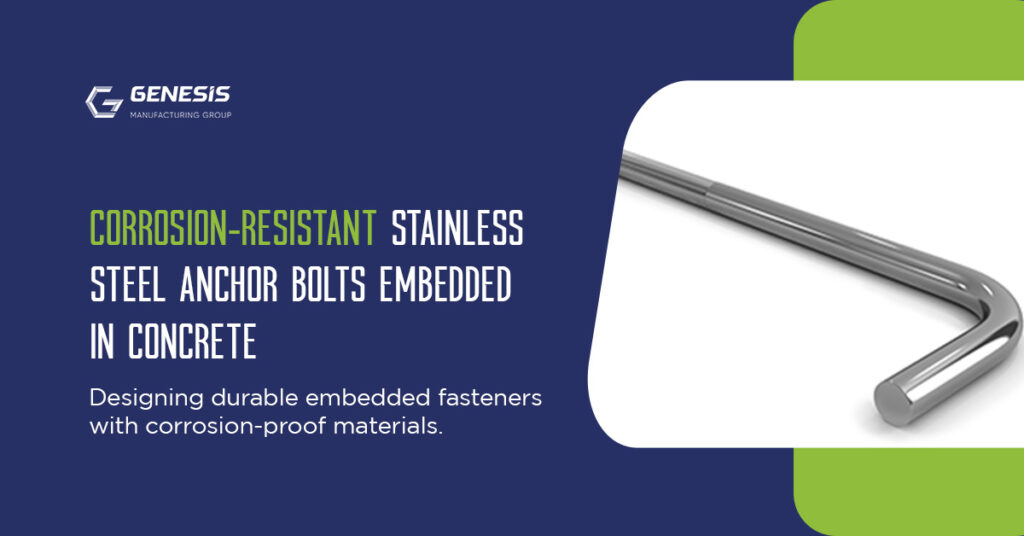
When engineers ask, “What metal offers the highest corrosion resistance inside concrete?” the correct answer is 304 stainless steel, 316 stainless steel, or duplex stainless steel, but specifically in the form of anchor bolts, threaded rods, inserts, and engineered fastening components, not nails. These grades are selected for environments where concrete fasteners face high chloride ingress or aggressive carbonation.
Where stainless-steel concrete fasteners are preferred:
- Marine and coastal foundations
- Wastewater treatment structures
- Chemical and industrial floors
- Parking decks with de-icing salts
- Long-life infrastructure where fasteners cannot be replaced
Why they perform well inside concrete:
- High resistance to chloride-induced pitting
- Stable passive layer that withstands carbonation
- Extremely long service life in harsh exposure classes
Grade differences:
- 304 SS – Suitable for moderate chloride exposure
- 316 SS – Higher molybdenum content → superior chloride resistance
- Duplex SS – Best-in-class strength + corrosion resistance
Note: Stainless steel is commonly specified for anchor bolts, threaded rods, inserts, and structural embedment hardware in concrete. Stainless-steel concrete nails are not used in structural concrete applications, and Genesis MG does not manufacture stainless-steel concrete nails.
Coating & Protection Strategies That Extend Service Life
Beyond material choice, protective coatings significantly improve durability. For embedded concrete fasteners, engineers rely on:
- Thick Zinc (HDG) Layers: Provides sacrificial protection and slows rust spread.
- Mechanical Galvanising: Uniform zinc distribution, useful for threaded fasteners.
- Epoxy Coatings: Barrier protection that prevents direct moisture contact. However, epoxy systems require careful handling and installation to avoid coating damage.
- Duplex Coating Systems: Zinc + polyurethane/epoxy topcoat → extended life in marine zones.
- Stainless Steel with Passive Film Protection: Naturally corrosion-resistant due to chromium oxide film.
The goal is always the same → Slow corrosion long enough that the fastener outlives the structure itself.
Design Considerations for Fasteners Embedded in Concrete
Choosing a corrosion-resistant fastener is one part of the equation. Engineers also consider:
- Embedment Depth & Coverage: Proper concrete cover protects the fastener from moisture and chemical infiltration.
- Avoiding Crevice Zones: Narrow gaps promote moisture retention → faster corrosion.
- Drainage & Moisture Control: Especially important in foundations, parking decks, and industrial floors
- Isolation from Dissimilar Metals: Prevent galvanic corrosion when using stainless steel near carbon steel, HDG near copper, brass, or aluminium.
- Structural Redundancy: Critical anchors are often oversized or doubled for long-term safety.
Understanding Durability: Expected Service Lives by Material
Service life predictions are not absolute values. They vary based on exposure class, chloride penetration rate, concrete cover depth, mix permeability, carbonation progression, and local environmental conditions. The ranges below provide a comparative guideline, not a fixed lifespan.
| Fastener Type | Typical Service Life in Concrete | Best Application Environment |
| Zinc-Plated | 1 to 5 years | Dry, interior conditions |
| HDG | 20 to 50 years | General outdoor construction |
| Mechanical Galvanized | 15 to 40 years | Moderate exposure |
| 304 Stainless Steel | 50 to 75+ years | Moderate chloride environments |
| 316 Stainless Steel | 75 to 100+ years | Coastal/marine |
| Duplex Stainless Steel | 100+ years | Extreme corrosion conditions |
Maintenance Tips for Corrosion-Resistant Fasteners in Concrete
Even the best materials benefit from long-term care. Some tips that can aid good maintenance include:
- Monitor exposed anchor heads for early signs of corrosion
- Ensure drainage systems function properly
- Seal cracks in concrete to prevent chloride intrusion
- Schedule periodic structural inspections
- Replace compromised fasteners before they affect load paths
The goal is proactive rather than reactive maintenance.
How Genesis MG Supports Long-Term Durability in Concrete Fastening
Genesis MG manufactures corrosion-resistant anchor bolts, threaded rods, U-bolts, inserts, and structural concrete accessories, produced under ISO-aligned quality systems with controlled raw material selection, precise forming, and reliable surface finishing.
For nail products, Genesis MG supplies galvanised and coated construction nails for wood, steel, and general construction, not stainless-steel concrete nails.
This distinction ensures that each product category is optimised for its intended application and exposure conditions.
Remember!
Fasteners embedded in concrete may be small, but they carry enormous responsibility.
Chlorides, carbonation, moisture, and long-term chemical exposure can all shorten their service life dramatically, unless the right combination of corrosion-resistant fasteners, materials, and coatings is chosen from the start.
Using rust-resistant materials, especially stainless steel or high-quality HDG fasteners, provides predictable long-term performance in environments where concrete alone cannot guarantee protection.
For engineers designing concrete structures that must last decades, material choice is a structural decision.